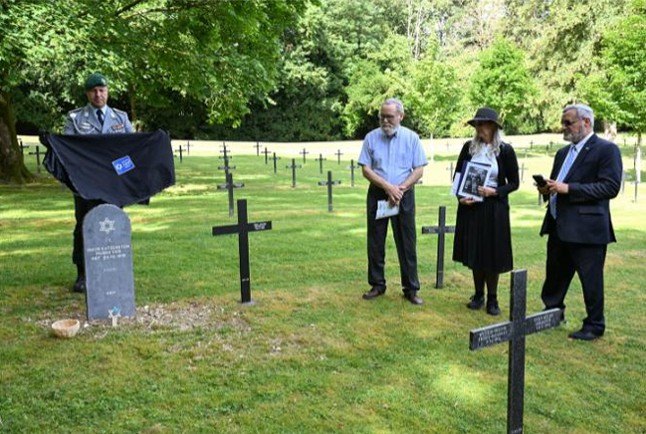
Jesse Hefter stood in a German military cemetery in northern France on July 3 and recited a mourner's prayer that was 108 years overdue.
The Chestnut Hill resident and Brookline School Committee member traveled to Saint-Quentin, France, to witness something his family never thought would happen: the placement of a Star of David headstone on the grave of his great-uncle, Isidor Katzenstein, an 18-year-old German Jewish soldier who died of wounds on Oct. 24, 1918 — less than three weeks before World War I ended. For 108 years, his grave had been marked with a Latin Cross instead.
What it felt like to finally stand there.
"I was overwhelmed," Hefter told Brookline.News. "To think that 108 years had passed since anyone in our family had been there, since anyone had said Kaddish for him. It was extraordinary."
How a mistake made a century ago finally got fixed.
The correction came through Operation Benjamin, a nonprofit that identifies Jewish soldiers from both World Wars mistakenly buried under crosses, working with its German partner program Operation Levi. Launched in 2025 in partnership with the German War Graves Commission, Operation Levi has already identified more than 700 similar cases among German Jewish WWI soldiers. Hefter's involvement began with an unexpected phone call in March from Shalom Lamm, the organization's co-founder and chief historian, who had tracked him down while searching for Katzenstein's descendants. Over the following months, Hefter worked with genealogical researcher Stefan Schweitzer, supplying family records that helped confirm his great-uncle's Jewish identity.
A ceremony built from fragments of memory.
At the July 3 ceremony, Hefter and other attendees read Psalms and a memorial prayer written specifically for grave-correction services by Rabbi Dr. Jacob J. Schacter, another Operation Benjamin co-founder. During the El Maleh Rachamim prayer, Hefter inserted the Hebrew name "Yitzhak" — his best approximation of "Isidor," since Katzenstein's original Hebrew name had been lost to history. Family members then placed small stones gathered in Israel atop the new headstone, a quiet ritual completing what history had left unfinished.
Hefter made the trip while undergoing chemotherapy for a rare cancer, timing it to a recovery week between treatments with his oncology team's approval.
A family history that runs through both World Wars.
Katzenstein's older brother Julius — Hefter's grandfather — fled Germany in 1938 and settled in the United States. Another sister, Regina, escaped to the Netherlands, was detained at the Westerbork transit camp, obtained false papers to reach Sweden, and eventually immigrated to the U.S. in 1947. Two other sisters, Selma and Meta, along with Selma's husband and children, were deported to Auschwitz and murdered. After World War I, German nationalists falsely claimed Jews had betrayed the country, and the Nazis later erased from public memory the service of more than 100,000 German Jews who fought in WWI — roughly 12,000 of whom were killed — by excluding Jewish veterans from official commemorations entirely.
Why this act matters so much in Jewish tradition.
Hefter described the burial rite as the highest level of charity in Judaism — one performed for someone who cannot know it happened and can never offer thanks in return.
Since returning from France, Hefter has spoken about Katzenstein's story at Jewish schools and community groups across Brookline. Operation Benjamin estimates that 600 to 900 American Jewish soldiers from both World Wars remain buried under crosses, and Operation Levi continues working through hundreds more cases across European cemeteries.