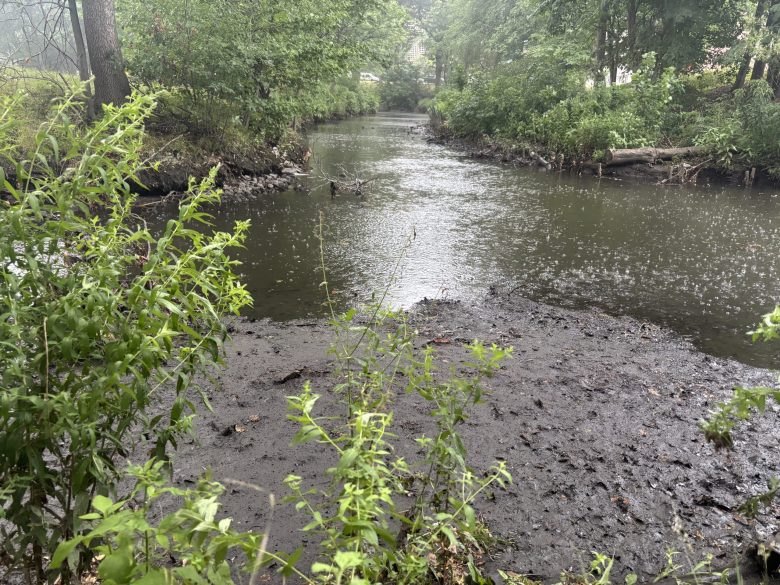
The state has committed $350,000 to figure out what's causing mudflats along the Muddy River and how to get rid of them, but at least one Brookline advocate says the money should go toward a fix, not another study.
Gov. Maura Healey signed the state budget on Wednesday, July 9, unlocking the earmark for a study to "evaluate and develop solutions to mitigate low water levels in the Muddy River." The Department of Conservation and Recreation will run the study in consultation with Brookline and Boston.
State Sen. William Brownsberger, a Democrat whose Suffolk and Middlesex district includes Brookline, pushed for the funding. He said DCR appeared prepared to begin work soon after the budget signing but acknowledged he did not know how long the study would take.
"We certainly need to go through the study before we can move forward," Brownsberger said. "A study like this is really the first step to actually implementing anything."
How the mudflats formed
The mudflats appeared after the Army Corps of Engineers wrapped up a roughly $90 million, decade-long restoration project in November 2023. During construction, the Corps erected a temporary metal cofferdam near Park Drive that controlled water flow. When the project ended, the cofferdam's superstructure was removed, and water flowed more freely downstream, dropping upstream levels and exposing stretches of riverbed between the Longwood Avenue Bridge and Park Drive, most visibly near the Chapel Street footbridge.
The citizen-led Maintenance and Management Oversight Committee voted on January 14, 2026, to support a study of alternatives. Health concerns include increased mosquito breeding in warmer, shallower water and potential exposure of heavy metals buried in the riverbed from decades of dumping, according to Fenway News reporting.
Advocates split on the solution
Caroline Reeves, co-founder of the Muddy Water Initiative, wants action, not analysis. Her group commissioned a study from the firm Terraphase Engineering, with additional funding from the state, the Brookline GreenSpace Alliance, and Friends of the Muddy River. That study supports reinstalling a flow restriction device at the cofferdam site.
"Instead of the solution to the problem, now it's funding an analysis of the situation," Reeves said of the state earmark.
Sean Lynn-Jones, president of the Brookline GreenSpace Alliance, said the low water has fueled invasive species growth on newly emerged islands, warmer temperatures, and algae blooms that harm fish and wildlife. He said he is open to any solution that works, including a combination of approaches.
Lisa Kumpf of the Charles River Watershed Association favors ecological restoration over hard infrastructure. She said CRWA prefers planting native vegetation on the mudflats, managing invasives, and potentially reconfiguring the channel in areas where the river is too wide for its current flow. She added that her organization has not made a final determination on whether that approach fits this situation.
What's next
A DCR spokesperson said the agency is working with local partners on a study that will provide "the scientific information needed to better understand the factors contributing to the low water levels." No timeline for completion has been announced, and no public comment deadline has been set.